Showing posts with label cotton. Show all posts

Tuesday, October 10, 2017

The PAST Inspires the PRESENT and Creates the FUTURE: Gerber Technology, Spoonflower and The Darnell Collection

This dress, made by Horrockses of London in the 1950s, is in the New Look style 
inspired by Christian Dior’s La Corolle collection, launched in February 1947. 
The dress' skirt is given extra fullness from an in-built, but detached muslin petticoat.  
John Horrocks set up a cotton goods company in Preston, England in the late 18th century (1791). 
By the 1950s, Horrockses was a household name producing off the peg summer dresses. Their fashion collection of pretty cotton dresses was created as an initiative to use and sell their own cotton.
Celebrities and even royalty, such as Princess Margaret, were noted fans and the brand was given a royal warrant in the 1960s.
Sadly, in the 70s and 80s, Horrockses dresses went out of fashion and the company subsequently closed. (N.B. The company has been resurrected and is selling a range of bed linen.)


When I was invited to travel to NYC to be filmed for an episode on Fox Business News' popular television series, Strange Inheritance, I wanted to bring relevance and sustainability to my collection and tell this story to their goal audience. 
What better than to look at my collection, and that of fashion history, from a perspective that showcases 
"The Past Inspires the Present and Creates the Future".

This is the future of dressmaking and The Darnell Collection wants to be a part of it!

So, I chose this feminine, summery party dress to bring to life my mission and worked with two cutting edge, 21st century, American companies 
Spoonflower and Gerber Technology. 

Spoonflower is one of the worlds largest digital printers and designers of custom made fabrics among many other digital services and products. (https://www.spoonflower.com)
Spoonflower used the wrapping paper design that was created for my new book, One Enchanted Evening (Affirm Press) and printed it onto cotton sateen and silk voile fabric. 


Gerber Technology, with whom I have worked with in the past bringing to life their Yunique PLM, AccuMark and CAD Software programs, provides integrated hardware and software solutions to the fashion industry around the world. (http://www.gerbertechnology.com)

Mary McFadden, Executive Director CAD Product Management at Gerber Technology, created a simulation of the dress on an avatar. A digital pattern was then made that Spoonflower used to make the 're-interpreted' Fifties dress.


With Gerber's digital pattern, Spoonflower was able to layout the pattern pieces onto the fabric and begin cutting out the pieces and then sewing them together.
And here is the finished result!
Modelled beside the original Horrockses of London dress.

Such an inspiring meeting of two centuries, three companies, the past and the present  

 to create a cutting-edge, technology driven 21st century dress.

This is the future of dressmaking and The Darnell Collection wants to be a part of it!


History of Aprons from The Darnell Collection on display at Blue Mountains Grammar School


'History of Aprons' on display at Blue Mountains Grammar School

A bit of apron power was on display at the Vintage Fair at the Blue Mountains Grammar School.

The history of the apron is long and fascinating. And if there is one garment that chronicles societies changing and evolving throughout history, it has to be the apron. The mere thought of the ‘humble’ apron takes us down memory lane.

During the 1950s and into the early 60s the apron became a cultural icon and symbolised the housewife as a ‘domestic goddess’, an attribute of which women were proud. EllynAnne Geisel, author of The Apron Book, calls the apron ‘armour of domesticity’.

My story on aprons will be featured in an upcoming issue of 'Vintage Made' magazine, Australia.
 
A very pretty (and heavily starched) hostess apron, 1950s
Posing on the school's front verandah 

100 years of aprons: a 1960s and an 1860s apron 

A Marks & Spencers apron from the 60s

Even the rain failed to damped the spirits of our apron models!


On display in their own marquee


Auscott Cotton Farm and The Darnell Collection: A Great Day Out

This week, I spent the day with fashion industry professionals in Narrabri, NSW, Australia as a guest of Cotton Australia and Auscott Ltd. I was immersed in the world of cotton and witnessed the journey cotton takes from its raw state on a plant in vast swathes of cotton fields through the laborious, but highly sophisticated process of deseeding and processing at the cotton gin before awaiting its exportation to spinning mills around the world who anticipate the arrival of each highly sought after bale of perfect Australian cotton.

What surprised me was how naturally white cotton is in its raw state. What bowled me over was learning how many steps are required to take cotton from field to fibre. What impressed me most was the sophisticated technology for which Australia is not only respected, but is recognised as a world leader in the cotton industry.

I hope you enjoy my adventure discovering the wonderful world of Australian cotton as much as I did.

For more information on this beautiful natural fibre:
www.cottonaustralia.com.au
www.auscott.com.au
www.thefabricofourlives.com
www.cottoninc.com


Ready for the flight! Private jet courtesy of Auscott Cotton 

In a sea of pure white cotton at the Auscott Cotton Farm in Narrabri, NSW

The Beast!

A natural wonder!
A spiky and tough stem protects and nurtures the downy fluff of cotton in its raw state

On board a cotton harvester at Auscott. The skill of manoeuvring a massive cotton harvesting machine down the narrow strips between the cotton plants is an art in itself. 

The serenity of cotton harvesters in the distance at Carberry Cotton Farm, Narrabri


'Cotton Gin Central' at Auscott.
This hub is literally pulsing with energy. Here, cotton gins run almost 24/7 deseeding and preparing the cotton fibres for export. Australia's cotton production is small compared to the big cotton producing countries like America and India, but it can proudly boast being the third largest exporter of cotton in the world 

The view looking down from the cab of a cotton harvester

Huge 2 tonne 'bales' of cotton waiting to be beautified by the cotton gins at Auscott

The 'moon buggy' drops its 2 tonne load - (straight out of a James Bond film)


Eli Whitney would stand proud knowing his invention of the cotton gin during the Industrial Revolution continues to shape the thriving cotton industry around the world

American Eli Whitney revolutionised the cotton industry (and changed the lives of American slaves in the process)

The pulsing energy of huge cotton gins deseeding millions of tonnes of raw cotton all in one space. Auscott Cotton Gin

The towering infrastructure at Auscott Cotton Gin in Narrabri NSW. The Georg Pompidou of Cotton Gins!

Raw cotton being prepared for its turn through the cotton gins

I am still amazed that huge, lumbering machinery can be so delicate in the harvesting of cotton

Our fabulous day ends as we head back to Sydney on board the Auscott jet as we look out over clouds as fluffy as cotton

Bustles or Tournures in The Darnell Collection

During a recent photo shoot I on which I collaborated with Cotton Australia as we build the world's first Cotton in Fashion History Digital Library, I found at the back of the storage unit a box of extraordinary late 19th century bustles.

Bustles like these were worn by fashionable ladies in the late 1880s. The soft layered look, popular in the pervious decade and immortalised so beautifully in paintings such as August Renoir's "Le Moulin de la Galette" in 1876, was replaced by a severe, tailored silhouette with an exaggerated (and often extraordinary) fullness at the back created by layers of fabric. Fixed around the waist of the wearer, a bustle, made from a framework of watch spring wire held in place by grommets attached to heavy-weight cotton cloth, supported the folds of fabric to create a stiff protrusion. Georges Seurat's "La Grande Jatte", painted in 1884, captured this very rigid silhouette perfectly.


What I found fascinating about these and the other bustles in the collection is the fine woven cotton thread that covers every inch of the watch spring wire. As much as for decorative purposes, the cotton covering protected the metal from dampness and rust.


Royal Sydney Easter Show 2016 and The Darnell Collection showcase Australian Natural Fibres


42 Parades Bring 4 Natural Fibres to Life at the Sydney Royal Easter Show

The Sydney Royal Easter Show is always fabulous fun and full-on! 
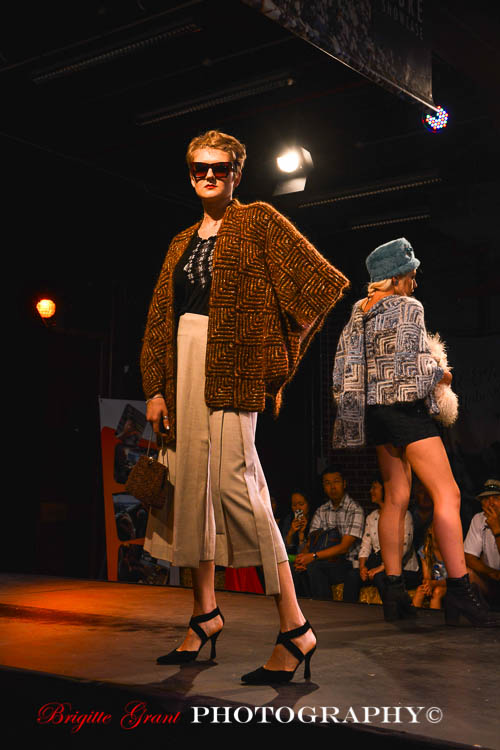
During the two week show forty two catwalk parades were held in the Natural Fibre Pavilion. We  showcased four fabulous natural fibres: Cotton, Wool, Mohair and Alpaca, all part of Australia's phenomenal agricultural industry.

This year, one hundred and nineteen students from Sydney's fashion, beauty, design and technology schools, along with high school students from the Blue Mountains, joined me to bring to life this marvellous story by wearing vintage garments and accessories from The Darnell Collection as well as many stunning new garments in each of the four fibres. A number of my models were fashion designers themselves and helped style their own garments and watched them as they hit the catwalk. The parades highlighted a unique journey from 'farm to fabric to catwalk'. 

Thousands of spectators watched our parades throughout the two weeks. Our message: 
"When you have the choice, buy and wear natural fibres. Support the industry, protect the environment, live a healthier life."
Long live 100% natural fibres and Australian manufacturing! 

Easter Weekend parades begin backstage!
VINTAGE COTTON, WOOL, MOHAIR and ALPACA

Garment was a WOOLMARK prize finalist in 2009
WOOL
Jessie works her magic backstage!
VINTAGE AUSTRALIAN
 COTTON
VINTAGE COTTON
VINTAGE MARIMEKO and JOE BANANA
COTTON
Comme des Garçons
VINTAGE WOOL
The Perfect Classic Sweater!
MOHAIR 
CLASSIC and NEW MOHAIR
 Makes an 'ordinary outfit extraordinary'
VINTAGE and CLASSIC NEW
ALPACA
ALPACA
Such a 'feel good' moment!
A nice jumble of VINTAGE COTTON and WOOL
From the 60s (Silver Star) to the 80s (Norma Kamali) to the 21st century (Vivienne Westwood)!
WOOL
VINTAGE WOOL and COTTON
Ready for the catwalk!
Easter Saturday crowds at the Natural Fibre Pavilion
VINTAGE and NEW
WOOL 
Without them (Alpacas AND their handlers) the industry would be nothing!
ALPACA
Off to Coachella in the 70s!
Wearing VINTAGE COTTON and WOOL
Last day of the Easter Show. 42nd parade!
VINTAGE COTTON
Models and fashion designers (James and Beau) draped with 100% Australian Mohair/Wool blend suiting fabric.
With Steve, President, Mohair Australia
VINTAGE COTTON
Photo by @RobertodeSollars#187kome
HISTORIC (1900 jacket) and VINTAGE (80s kilt)
WOOL
Photo by @RobertodeSollars#187kome
Designed by TAFE St. George student Fatima Berry.
MERINO WOOL
Photo by @RobertodeSollars#187kome
 CLASSIC and NEW
ALPACA with a BOHO twist!
Photo by @RobertodeSollars#187kome
VINTAGE. ALPACA
Photo by @RobertodeSollars#187kome
 CLASSIC and NEW
ALPACA
Photo by @RobertodeSollars#187kome
VINTAGE ALPACA
Photo by @RobertodeSollars#187kome
VINTAGE WOOL
Photo by @RobertodeSollars#187kome
VINTAGE WOOL
Photo by @RobertodeSollars#187kome
SUPER MODELS
ALPACA
Photo by @RobertodeSollars#187kome
100% AUSTRALIAN MOHAIR/WOOL BLEND SUITING FABRIC
MOHAIR
Photo by @RobertodeSollars#187kome
CLASSIC VINTAGE LEVI and R.M. WILLIAMS
COTTON
So James Dean! VINTAGE COTTON